
ORIENTATION GUIDE
SoBe's Why, What, How and Who

The ‘Why’ that drives SoBe
Remember when AI felt futuristic?
Then promised?
Then productised?
Then… here?
Everywhere, all the time, all at once?
Writing from the time-slice of November 2025 - a moment when “the future is here, if unequally distributed” - means writing from a world where AI is no longer an imagined horizon. It’s the fabric of the ‘now’: increasingly threaded through our personal, professional, social, and planetary spheres alike.
AI-mediated change is unfurling faster than our existing frameworks (ways of thinking, our systems, our governance models) can metabolise. It is reshaping how we work, think, relate, and shape change - becoming intimately woven into both our inner lives and collective ecologies. Altering how we relate to ourselves, each other, and our visions for the future.
How do we make sense of the world-shifts, challenges, and possibilities unfolding? How do we shape change for the future when our present doesn’t yet make sense?
SoBe begins from a simple premise:
The only healthy way to navigate the suddenly-here AI era is together.
When technology is prismatic in its impact, our thinking and way of meeting it must be too. And understanding what is happening - and what could - are not things we can delegate to any single structure, system, discipline or worldview.
SoBe exists to hold that multiplicity. In what we talk about; in how we make sense of it.
What we explore in this space
SoBe is a place to think about AI and intelligence more broadly: human, synthetic, collective. In doing so, the intention is to expand rather than narrow our sense of what’s possible, oriented via a magpie-intuition for the frames that feel most beautiful or needed in this moment.
We explore how AI behaves not only as code, but as something that moves through complex human ecologies: shaped by context, relation, expectation, design, constraint, and use.
We look at what becomes visible when we treat AI not as a fixed object but as an unfolding system interacting with other unfolding systems.
And we invite to the collective dinner table perspectives that rarely sit in the same room: cognitive science, collective and ecological intelligence studies, computational mechanics, philosophy, lived experience, (neuro)divergent wisdom, governance, aesthetics, relational design, somatics, organisational behaviour, ethics - and creative practice.
Cross-thinking helps illuminate what each lens reveals, what they miss, and what comes into focus when they stack together.
What to expect
Analysis, explanation, and dialogue about:
The topology of the moment we’re living through
Why everything feels fast, strange, dissonant, or porous - and what that means for collective sense-making.How AI systems behave in the wild, including beyond productised intent
Mechanics, architectures, drift, conditioning, context effects, relational edges.
Explored from a place of curiosity (no hype-cycles, no doom-mongering).How humans relate to AI - and what that reveals about us
Attachment, projection, patterning, (neuro)divergence, desire, fear, power, play.
Why divergent body-minds may experience synthetic intelligence differently.
What ‘safety’, ‘benefit’ and ‘harm’ mean to us in our multiplicity.What shapes people’s radically different experiences with the same models.
What language, metaphors, and narratives are shaping the AI era.
Which stories clarify, which mislead, which are too small, and which help us think more widely, wisely, or honestly.Needed evolutions in inherited governance and policy logics
Where our frameworks break under complexity and speed - and what becomes possible when we stop treating control as our only design principle.
About us: the ‘divergent intelligences’ shaping SoBe
SoBe is curated by Caitlin: a multiply-divergent writer, parent, complexity-organiser, story-teller, and sometimes artist. It is indelibly shaped by all of me, in conversation with everything, with particular imprinting from:
philosophy, art and literature on self, other, consciousness and connection
multi-disciplinary studies on cognition, emotion, and embodied intelligence
decades supporting digital transition efforts (and where it tended to fail)
studies of power dynamics and norms shaping tech, psychiatry, science
participatory research practices and design thinking, in all its forms
shape-shifting through academia, social/sciences, and corporate spheres
the ways brains, bodies and systems fall apart/put themselves together again.
Over time, hopefully increasingly, SoBe will be shaped by others - invited in to share, discuss or co-translate. We’re prioritising perspectives that help us explore AI in ways that dominant frames do not, and voices who translate ideas and experiences in ways readers can learn with. Personality, and art, are welcome.
If this resonates and you’d like to submit a piece, collaborate on co-writing, be involved in future discussion, or offer support - get in touch.
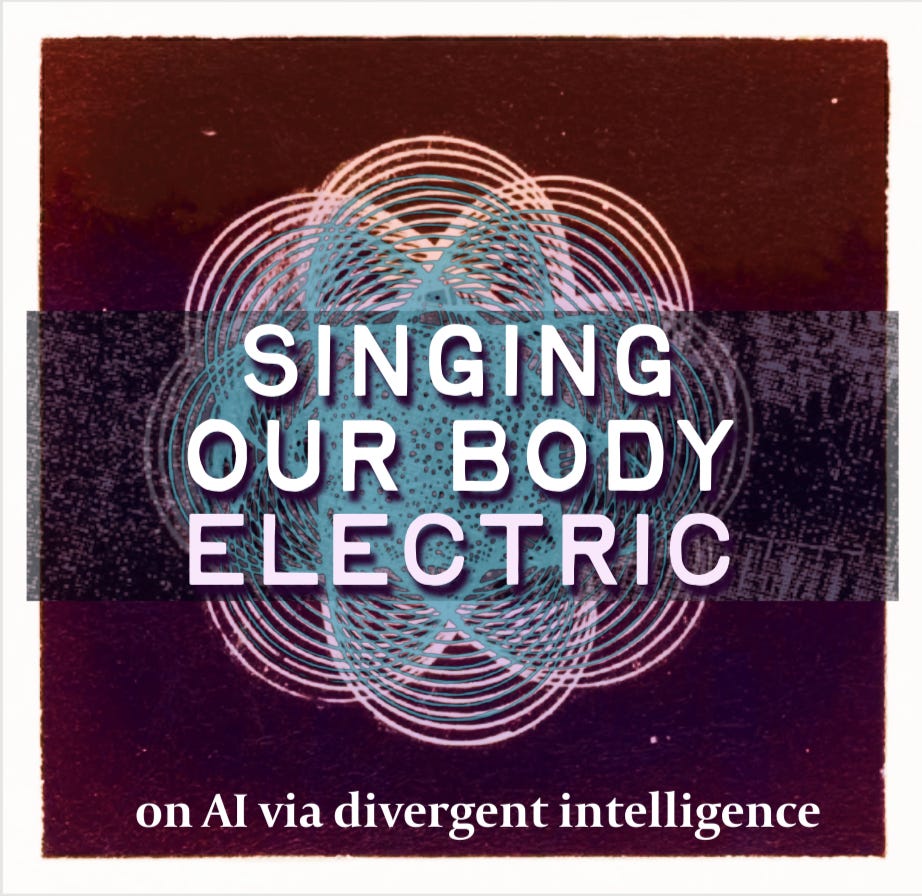
Art credits
Images with back stories worth your time in their own right are marked (*).
SoBE image-hybrid remixed in Adobe by Caitlin from the below.
Specimens of Fancy Turning (1869), Edward J. Woolsey (public domain, PDR)*
“Pure electography of the hand by Iodko’s method.” Hippolyte Baraduc, The Human Soul: Its Movements, Its Lights, and the Iconography of the Fluidic Invisible, Paris: Librairie Internationale de la Pensée Nouvelle, 1913.(public domain, PDR)*
“High Voltage“ by Easa Shamih (iZZo) | P.h.o.t.o.g.r.a.p.h.y (CC by 2.0)


Love this!
And when it comes to this -- "the ways brains, bodies and systems fall apart/put themselves together again" -- are you familiar with something called the theory of positive disintegration?